


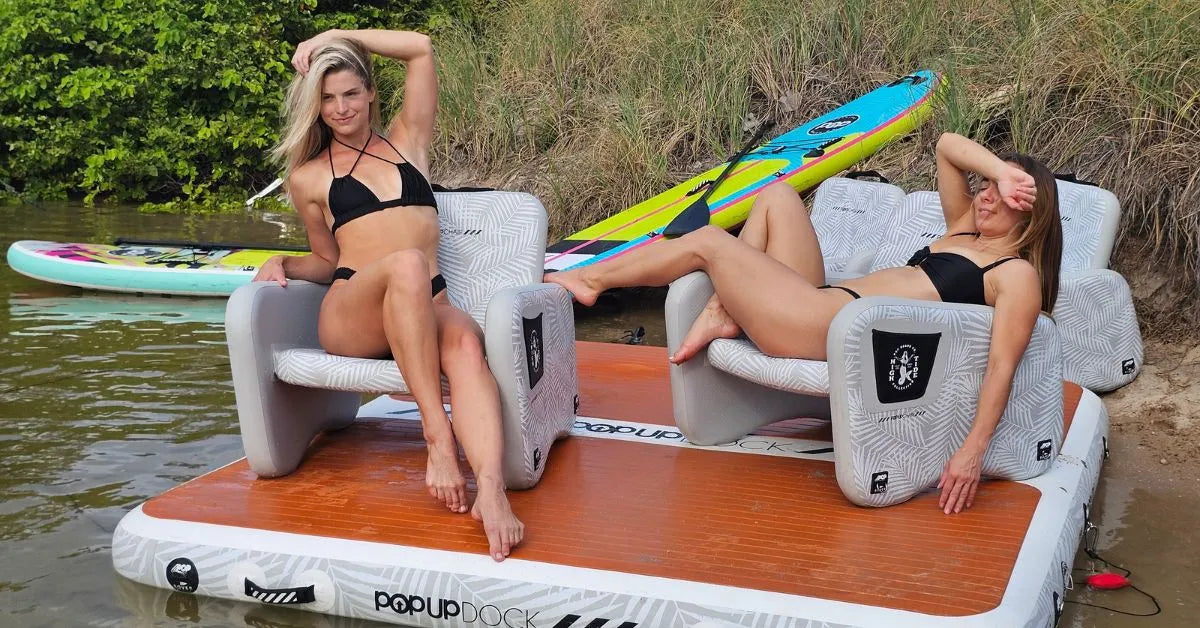
Hard docks made sense when waterfront property was simpler. Fixed structure, permanent installation, done. But for most lakefront homeowners today — dealing with permit requirements, seasonal water level changes, HOA restrictions, and the desire to actually use their waterfront for more than one thing — a permanent dock is often the wrong tool for the job.
Inflatable floating docks solve most of those problems. Here's an honest look at why, and what to consider before you buy.

The Environmental Case Worth Knowing
Before getting into the practical benefits, it's worth understanding why many lakefront communities and HOAs are moving away from permanent dock installations altogether. Fixed docks have documented ecological impacts — particularly in estuaries and shallow coastal waters where dock proliferation affects shoreline habitat.
Residential Docks, Recreation & Environmental Impact
Small docks and floats are common in estuaries and coastal waters worldwide. These structures serve a role in coastal recreation by facilitating access to waterways. However, they can impact shoreline ecological function. While individual environmental impacts are generally minor, increasing dock proliferation and overlap with sensitive coastal resources can result in cumulative impacts that pose threats at the ecosystem level.
A review of habitat impacts from residential docks and recommended best management practices with an emphasis on the northeastern United States, JM Logan, 2022
Inflatable docks are deployed and retrieved seasonally, leaving no permanent footprint. For homeowners in regulated waterways or sensitive lake ecosystems, that matters — both for compliance and for the long-term health of the water they're living on.
Stability: Better Than You'd Expect
The most common objection to inflatable docks is stability. People assume inflatable means wobbly. It doesn't — not with drop-stitch construction.
Drop-stitch fabric connects the top and bottom layers of the dock with thousands of polyester threads, creating a structure that stays rigid under pressure. At the correct inflation PSI, a quality inflatable dock is a solid, stable platform — not a pool toy. The research on drop-stitch materials confirms it:
Inflatable Drop Stitch: Rigidity & Load Capacity
Inflatable drop stitch fabric materials can form rigid shapes that resist bending and bowing better than those utilizing standard fabric materials. The inflated drop stitch panels can be highly pressurized to allow for greater load capacity and provide a more robust resistance to loads and damage in hazardous environments.
Exploration of the mechanical properties of both ridged and inflated drop stitch fabric material, 2015
Where inflatable docks actually outperform hard docks is in wave action. A rigid dock transfers wave energy directly to its structure and anchoring system. An inflatable dock absorbs it. In choppy conditions or boat wake, that makes a meaningful difference in how stable the platform feels underfoot.

Hard Dock vs. Inflatable Dock: The Honest Comparison
| Factor | Inflatable Dock | Hard Dock |
|---|---|---|
| Installation | No permits, no construction, setup in under 30 min | Permits often required, professional installation |
| Cost | Lower upfront, minimal ongoing maintenance | High upfront, ongoing maintenance and repair costs |
| Portability | Deflates to a bag, transport anywhere | Permanent — can't be moved |
| Seasonal storage | Deflate, rinse, store in a closet | Requires winterization or removal service |
| Wave absorption | Absorbs wave action, stable in chop | Transfers wave energy, can feel unstable in wake |
| Environmental impact | No permanent footprint | Documented habitat impacts in sensitive areas |
| Repair cost | ~$10 patch kit for most damage | $100–$500+ for professional repairs |
| Weight capacity | Up to 2,500 lbs depending on model | Varies widely by construction |
Setup: Under 30 Minutes, No Tools
There's no construction, no permits, no contractor scheduling. Unroll the dock, connect your pump, inflate to the recommended PSI, deploy your anchors, and you're done. With an electric SUP pump the inflation is hands-free — set the target pressure, walk away, come back when it's done. Larger docks take 15–20 minutes; smaller platforms less.
At the end of the season: deflate, rinse with fresh water, dry, roll up, store in a bag. No winterization service, no dock removal crew, no spring reinstallation bill.
Anchoring for Your Conditions
How you anchor matters more than most people realize. Docks have a large surface area and catch wind and current — a single anchor isn't enough. For most calm lake setups, we recommend a 5 lb marine mushroom anchor kit (no sharp corners — important for protecting the dock material) with a minimum of two anchors set at opposing corners.
Adjust based on your conditions:
- Calm lake or protected cove: 2x mushroom anchors, standard scope (5:1 depth-to-rode ratio)
- Tidal or mild current: 3–4 anchors, longer rode, add a stern anchor to prevent swing
- Strong current or exposed water: Deadweight or helical anchors, multi-point system, shorter scope
- Rocky bottom: Grapnel or deadweight — mushroom anchors need soft bottom to set properly
Check lines at low and high tide if you're in a tidal area. Slack at one point means tension at another.

What You Can Do on an Inflatable Dock
Because these platforms are portable, you're not locked to one spot. Anchor off your lakefront, drop one off the back of a boat, haul it to a sandbar — the use cases shift depending on which model you're working with.
Swimming and sunbathing — all models
Stable platform, no splinters, softer surface than wood or composite decking. The 14' POPUP AQUADOCK gives you 98 sq ft — enough for a full family to spread out. Multiple AQUADOCK platforms can be connected together if you need even more space.
Extending your boat's swim platform — 14' Yacht Dock
Boats and yachts with small swim platforms don't give you much room once you're in the water. The Yacht Dock deploys off the stern and gives everyone a proper place to hang out, jump from, and climb back onto — without crowding the boat. It's a floating extension of your vessel, not a replacement for it.
Lounging half in the water — 8' POPUP AQUANET
The AQUANET has a built-in mesh cooling net section alongside a solid deck — so some people stay dry while others soak. Ideal for hot days when you want to stay cool without treading water. At 29 lbs it's the most portable option in the lineup.
Sandbar and social setups — POPUP DOCK 8x7 and VS Party Barge
Both Party Barge models are built for exactly this: anchor at a sandbar, pull up alongside other boats, and have a proper floating platform for the group. 14 stainless D-rings on the POPUP DOCK, 1,200 lb capacity on the VS Party Barge. Both have a beer pong template on the bottom if that's the vibe.
Fishing — 14' POPUP AQUADOCK
The AQUADOCK's 98 sq ft of deck space and high capacity make it the best fishing platform in the lineup — room for gear, coolers, rods, and multiple anglers without anyone getting in each other's way.
Paddleboard and kayak launch
D-rings on all models let you tie up boards and kayaks while you load gear or swap paddlers. Easier than launching from shore, especially on rocky or weedy banks.
Weight Capacity: More Than You'd Think
Our dock lineup ranges from 700 lbs (8' POPUP AQUANET) up to 2,500 lbs (14' Yacht Dock). That's not pool-toy territory — that's a platform that handles a full group of adults with gear, coolers, and equipment. The key is not running at the limit: a dock loaded to capacity sits lower and feels less stable. Factor in everyone and everything before choosing your model.
Durability: What Actually Holds Up
Military-grade PVC with UV-resistant coating, welded seams, and stainless marine-grade D-ring hardware. That's what separates docks that last a decade from ones that fail after two seasons. Hard docks crack, delaminate, and corrode — especially in freshwater environments where freeze-thaw cycles stress the structure every winter. A quality inflatable dock bounces off the same impacts and costs $10 to patch if something does happen.
The main enemies of inflatable dock material are UV exposure and trapped moisture. Store out of direct sunlight and dry completely before rolling up. Do that consistently and the dock lasts.
Maintenance: What It Actually Takes
- Rinse with fresh water after every use — especially important in salt or brackish water
- Dry completely before rolling up — trapped moisture causes mold and degrades PVC
- Inspect valves and seams periodically — catch small issues before they become big ones
- Store in a cool, dry place out of direct sunlight
- Repair kit on hand — most punctures are a 10-minute fix with the right patch
Safety Considerations
- Life jackets for children on or near the dock — always
- Keep a retrieval line on the dock even when anchored — conditions change fast
- Check weather before deploying — wind turns a dock into a sail quickly
- Don't exceed weight capacity — a dock at its limit is noticeably less stable
- Supervise children; the dock surface is forgiving but open water is not
Frequently Asked Questions
Do I need a permit for an inflatable floating dock?
In most cases, no — but regulations vary by state, county, and waterway. Inflatable docks are generally classified as temporary structures and don't require the same permitting as permanent fixed docks. Check with your local waterway authority or HOA before deploying, especially in regulated lakes or coastal areas.
How long does it take to set up an inflatable dock?
15–30 minutes depending on dock size and pump type. Electric pump cuts inflation time significantly and is hands-free. First-time setup takes longer as you work out your anchor configuration — budget extra time on day one.
Can I leave an inflatable dock out all season?
Yes, with proper anchoring and periodic checks. Inspect your lines and pressure regularly, especially after storms. Deflate and store during extended periods of non-use or when severe weather is forecast. Most homeowners deploy for the season and retrieve in the fall.
How do I anchor an inflatable dock so it doesn't drift?
Use at least two anchors set at opposing corners — a single anchor lets the dock swing and puts uneven stress on your lines. For calm lake use, 5 lb marine mushroom anchors (no sharp corners) are the standard recommendation. Adjust anchor type and quantity based on current, tide, and bottom conditions. See the anchoring section above for condition-specific guidance.
What's the weight capacity of your inflatable docks?
It depends on the model — from 700 lbs on the 8' POPUP AQUANET up to 2,500 lbs on the 14' Yacht Dock. Always factor in gear and passengers, not just body weight, and give yourself margin below the rated limit.
Browse our full lineup of inflatable floating docks, explore all water sports gear, or check out inflatable boats and catamarans to expand your waterfront setup.

Leave a comment
All comments are moderated before being published.
This site is protected by hCaptcha and the hCaptcha Privacy Policy and Terms of Service apply.