


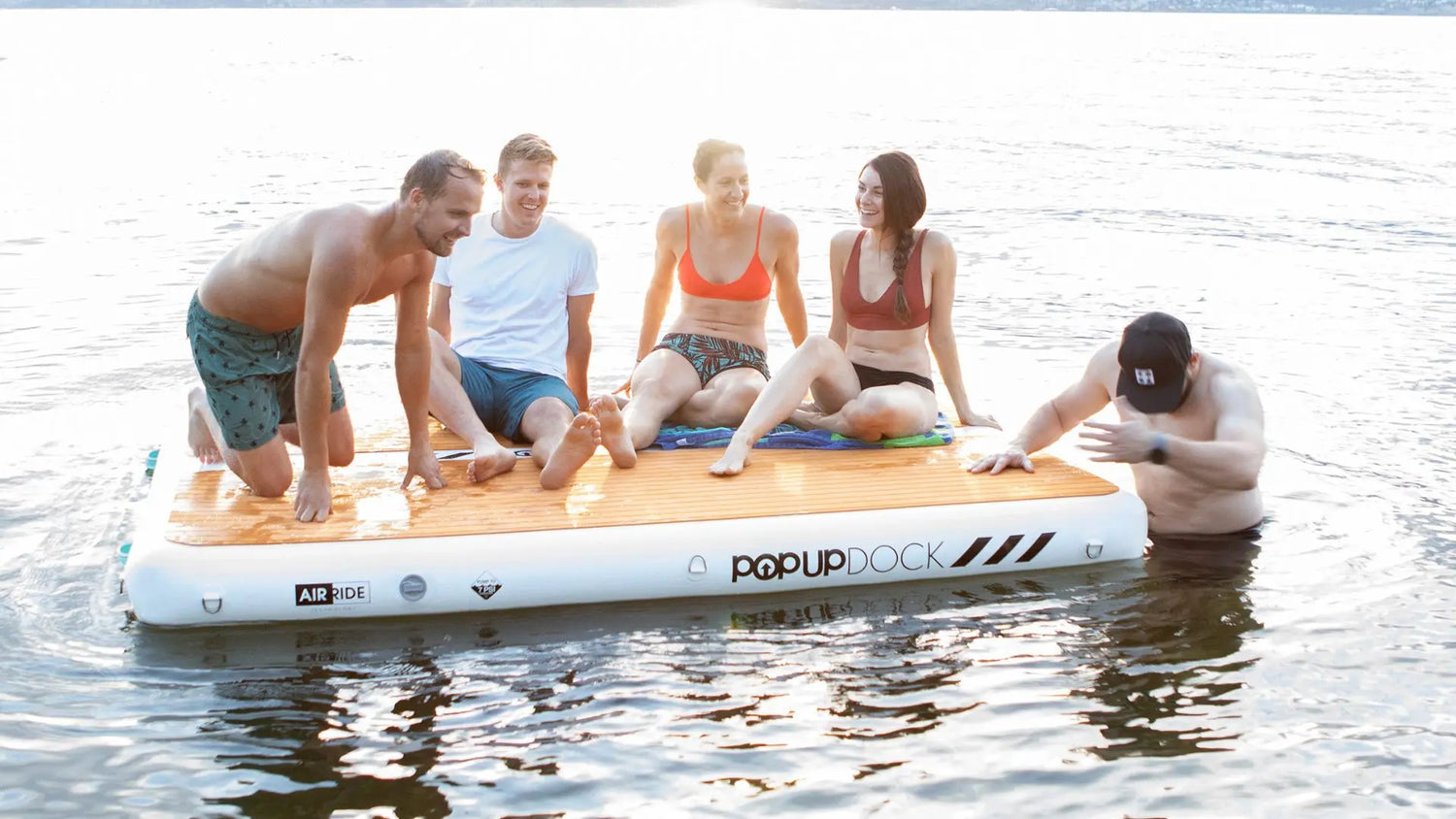
Setting up an inflatable floating dock is straightforward once you know what you're doing. This guide covers everything from picking the right spot to anchoring it properly for your conditions — calm lake, tidal water, or off the back of a boat.

Step-by-Step Setup Guide
1. Choose the Right Location
Look for calm water with at least 3 feet of depth — enough to keep the dock from grounding out and give your anchors room to set. Avoid high-traffic boat lanes and areas with strong, unpredictable currents. Protected coves, lake shores, and calm beach breaks are ideal. The calmer the water, the simpler your anchor setup needs to be.
2. Inspect and Prepare the Dock
Before you inflate, lay the dock out flat and do a quick visual check — look for any scuffs, seam stress, or valve issues from storage. Clear the area of sharp objects. A few seconds of prep here saves a lot of hassle on the water.
3. Inflate to the Right PSI
Use a high-pressure pump and inflate to 7 PSI — the recommended inflation pressure for our inflatable docks. Inflate evenly and check for any bulging that might indicate an uneven fill. Temperature affects air pressure, so if you inflate in the morning and leave the dock in direct sun, expect some expansion — check pressure periodically on hot days.
4. Anchor It for Your Conditions
This is where most people underestimate what's needed. See the full anchoring section below — your setup should match your water conditions, not just whatever came in the box.
5. Mooring to a Boat
If you're deploying the dock off a boat, use multiple D-ring attachment points to distribute the load. Don't tie off to a single point — balance the load across the dock to prevent torque and tipping. Cleats and carabiners work well here; avoid knots that are hard to release quickly.
6. Safety on the Water
Life jackets for kids, always. Check conditions before you deploy — wind picks up fast and a dock becomes a sail. Keep a line on the dock even when anchored so you can retrieve it quickly if conditions change.
7. Post-Use Care
Rinse with fresh water after every use, especially in salt or brackish environments. Dry completely before rolling up — trapped moisture causes mold and degrades the material over time. Roll, don't fold.
8. Seasonal Storage
Deflate carefully, rinse, dry, and store in a cool dry place out of direct sunlight. UV exposure is the main enemy of PVC over time. A storage bag keeps everything together and protects the material between seasons.

Anchoring Your Inflatable Dock: What Actually Works
The right anchor setup depends on where you're using the dock. There's no one-size-fits-all answer — tide, current, bottom type, and whether you're anchoring from shore or off a boat all affect what you need.
Our Go-To: Marine Mushroom Anchor Kit (5 lb)
For most dock setups, we recommend a 5 lb marine mushroom anchor — specifically a kit designed for inflatable docks with no sharp corners or exposed hardware that could damage the dock material. For a full-size inflatable dock, use 2 or more. One anchor isn't enough to prevent swing and drift; two anchors set at opposing corners give you a stable, controlled position.
Mushroom anchors work by settling into soft bottoms — sand, silt, mud — and using their weight and shape to resist pull. They're quiet, snag-free, and safe around inflatables. They're our standard recommendation for calm lake use, protected beach setups, and off-the-boat deployments in mild conditions.
Choosing Your Setup Based on Conditions
Calm lake, pond, or protected cove
2x mushroom anchors at opposing corners. Standard scope (5:1 depth-to-rode ratio). This is the simplest and most common setup — works well for most recreational dock use.
Tidal areas or mild current
Step up to 3–4 anchors and increase your rode length to account for tidal depth changes. Add a stern anchor to limit swing — without it, the dock will weathervane with the current and put uneven stress on your lines. Check your lines at low and high tide; slack at one point means tension at the other.
Strong current or exposed coastline
Mushroom anchors won't hold reliably in strong current — they need a soft bottom and relatively calm conditions to stay set. Switch to heavier deadweight anchors or helical (screw-in) anchors for better holding power. Use a multi-point system with shorter scope to limit movement. If you're in a location with significant surge or swell, reconsider whether a floating dock is the right tool for that spot.
Rocky or hard bottom
Mushroom anchors don't set on hard bottoms — they just sit there and drag. Use a grapnel anchor (hooks into rock crevices) or a deadweight anchor (relies on mass, not burial). Both work without needing to penetrate the bottom.
General Anchoring Tips
- Always use more anchor points than you think you need — docks have a large surface area and catch wind and current more than a boat hull does
- Use anchor lines with some stretch or add a snubber — rigid lines transfer shock loads directly to the dock's D-rings
- Check your setup after the first hour; anchors can drag slightly as they settle, especially on a new bottom
- If you're anchoring in a location you haven't used before, set up conservatively and observe for 15–20 minutes before leaving the dock unattended
Tools and Gear You'll Need
- High-pressure electric pump — hands-free inflation with auto shut-off at target PSI; cuts setup time significantly vs. a hand pump
- Repair kit — keep one on the water, not in the garage
- Anchors and rode — sized and selected for your conditions (see above)
- D-ring carabiners and cleats — for clean, releasable connections at attachment points
Choosing the Right Dock Size and Capacity
Match the dock to how you're actually using it. Key factors:
- Weight capacity: Count everyone and everything — people, gear, coolers, dogs. Most of our docks handle 1,000–2,500 lbs depending on model. Don't run at the limit; a dock loaded to capacity is sluggish and less stable.
- Surface area: More people or activities (yoga, fishing, lounging) need more deck space. Bigger docks also catch more wind and current, which affects your anchor requirements.
- Waterfront dimensions: Measure your launch area. A dock that's hard to get in and out of the water won't get used.
Materials: Why It Matters
Quality inflatable docks use military-grade PVC with drop-stitch construction and reinforced seams. This isn't pool-toy material — properly constructed inflatable docks are impact-resistant, UV-stabilized, and repairable in the field. Hard docks crack and delaminate; a quality inflatable bounces off the same impact and costs $10 to patch if something does happen.
Look for welded seams (not glued), UV-resistant coating, and stainless or marine-grade hardware on D-rings and valves. These details separate docks that last a season from ones that last a decade.
Inflatable vs. Hard Dock: The Short Version
Hard docks are permanent infrastructure. Inflatable docks are deployable platforms — you take them where you need them, set up in under 30 minutes, and store them in a bag. For most recreational users, families, and anyone without a fixed waterfront, inflatable wins on every practical dimension: cost, portability, storage, and repairability. The only real advantage of a hard dock is permanence — if you want something bolted to a piling that you never have to think about, that's a different product category entirely.
Frequently Asked Questions
How many anchors do I need for an inflatable dock?
At minimum, two — set at opposing corners. For tidal or current-affected water, use three to four. A single anchor lets the dock swing freely, which puts uneven stress on your lines and makes the platform less stable for users.
Can I use a mushroom anchor on any bottom type?
No. Mushroom anchors work on soft bottoms — sand, silt, mud. On rock or hard-packed gravel, they won't set and will drag. Use a grapnel or deadweight anchor on hard bottoms.
How long does it take to set up an inflatable dock?
With an electric pump, most docks are inflated and in the water in under 30 minutes. Hand pump adds time and effort. First-time setup takes longer as you figure out your anchor configuration — budget an extra 15–20 minutes.
Can I anchor an inflatable dock off a boat?
Yes — this is one of the most common use cases. Deploy from the stern, use multiple D-ring attachment points, and balance the load across the dock. In calm conditions with mild current, 2x mushroom anchors off the dock's far corners keeps it stable and away from the hull.
What PSI should I inflate my dock to?
7 PSI is the recommended inflation pressure for our inflatable docks. Don't over-inflate — exceeding the recommended PSI stresses the seams and can cause damage, especially in warm weather when air expands inside the dock.
How do I store an inflatable dock between uses?
Rinse with fresh water, dry completely, deflate, roll (don't fold), and store in a cool dry place out of direct sunlight. UV and trapped moisture are the two main causes of premature material degradation.
Browse our full lineup of water sports gear, inflatable boats and catamarans, and SUP accessories to build out your setup.


Leave a comment
All comments are moderated before being published.
This site is protected by hCaptcha and the hCaptcha Privacy Policy and Terms of Service apply.